
Marine Diesel Basics – Enhanced Troubleshooting FAQs
Understand your engine. Learn how your systems work. Sail with confidence.
Starting, Fuel and Power Problems
An engine needs air (oxygen), heat from compression and correctly delivered fuel to start. First distinguish between an engine that cranks slowly and one that turns at its normal speed but does not fire.
During cranking, the pistons compress the air in the cylinders, raising its temperature. If cranking is too slow, the air may not get hot enough to ignite the fuel.
Note any exhaust smoke, whether the engine is cold or warm, and what changed before the problem began. These observations help determine which checks to follow.
Topics to investigate
- Cranking speed: Slow cranking can prevent the engine developing enough compression heat to ignite the fuel.
- Stop control: A stop mechanism that remains in the STOP position prevents fuel delivery for starting.
- Fuel supply: Interrupted fuel flow or air in the system can prevent fuel reaching the injection equipment correctly.
- Cold-start assistance: Glow plugs, intake-air heaters and other starting aids must operate as specified for the engine.
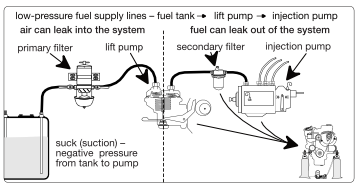
Air can enter through loose connections (e.g. loose hose clamps), damaged hoses or a poorly sealed primary filter on the suction side of the fuel system. Because this part of the system operates below atmospheric pressure, air may enter without fuel visibly leaking out.
After the lift/transfer pump, the fuel supply is under low positive pressure to the secondary fuel filter and injection pump. A leak here normally allows fuel to escape while the pump is operating. After shutdown, air may enter through the leak if fuel drains away. Check for fuel-wet spots on the underside of hoses and around connections and filter housings.
Air can also remain in the filter assemblies (both primary and secondary) after filter changes, or enter if the tank has been run very low and the fuel pickup becomes uncovered, particularly as the boat moves.
If bleeding the fuel system before an engine start only helps temporarily, the fuel supply system should be checked for leaks, including filter housings and seals.
Topics to investigate
- Air leaks: Damaged or loose hoses, loose hose clamps and connections from the tank to the fuel lift/transfer pump can admit air whenever the pump draws fuel.
- Filter seals: A twisted, damaged, misaligned or poorly seated seal can allow air into the primary filter housing.
- Priming and bleeding: Operating the priming pump and following the engine’s bleeding procedure removes trapped air and fills the system with fuel.
There can be many reasons why an engine loses power under load:
- Restricted fuel flow may provide enough fuel at light load but not when more power is required.
- Restricted air flow can limit the air available for combustion as load increases.
- A fouled propeller or hull can increase the load and prevent the engine reaching its normal rpm.
Note whether the engine produces more smoke as it loses rpm. If engine rpm rises while boat speed falls, investigate the transmission and propulsion system.
Topics to investigate
- Fuel restrictions: A fouled fuel filter, kinked hose or blocked tank pickup can limit fuel delivery as demand increases.
- Air supply: A blocked air cleaner or damaged intake hose can restrict the air available for combustion.
- Propeller loading: Fouling, damage or an unsuitable propeller can place more load on the engine than it can handle.
- Transmission: Loss of drive between the engine and propeller can reduce boat speed even when the engine maintains or increases rpm.
An engine may start and run for a time, then stop because the fuel supply is restricted or interrupted. Possible causes include air entering the system, a restricted filter or a blocked fuel tank vent. A fault in an electrical stop-control can also stop the engine. Note whether it slows or surges before stopping, or stops abruptly as though the stop control has been operated.
Topics to investigate
- Fuel supply: A supply problem may become apparent only after the engine has used the fuel initially available in its filters and lines.
- Tank ventilation: A blocked vent can allow a vacuum to develop as fuel is consumed, progressively restricting delivery.
- Stop controls: A faulty cable, solenoid or electrical circuit can operate the stop mechanism unexpectedly.
Restricted fuel filters may cause loss of power, surging or stalling, particularly under load. A filter can be restricted even when its contents look clean because many of the particles can be too small for human eyes to see. Best practices are to either install a vacuum gauge on the primary fuel filter, or in the line from the filter, or the lift/transfer pump, or change the filter after a pre-determined number of engine hours. The number of hours will depend on the original cleanliness of the diesel fuel. Repeated blockage calls for investigation of the fuel and tank, rather than repeated filter replacement alone.
Topics to investigate
- Filter restriction: A vacuum gauge helps establish whether resistance to fuel flow is excessive under the conditions being tested – is flow restricted only as rpm approaches wide-open throttles (WOT)?
- Fuel contamination: Water, sediment and microbial debris can contaminate the fuel and shorten the service life of both the primary and secondary filters.
- Tank cleanliness: Contamination remaining in the tank can repeatedly reach and block replacement filters each time the contamination is stirred up by the movement of the vessel in a seaway.
Cooling System Problems
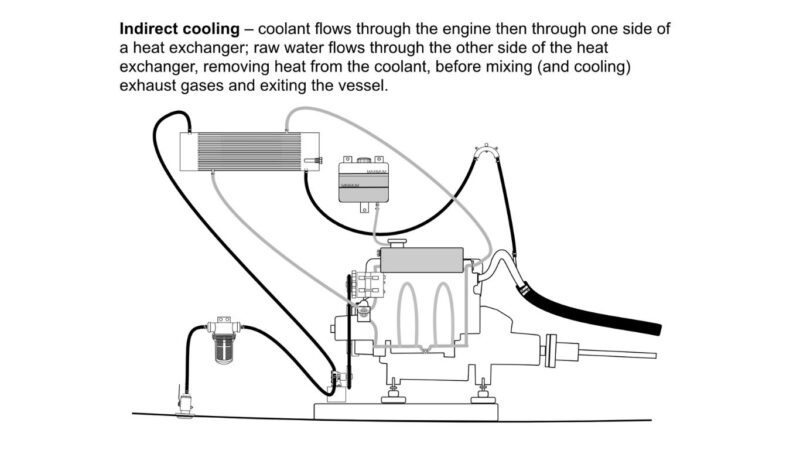
Overheating can result from several factors, including inadequate raw-water flow, poor coolant circulation or poor heat transfer between the two circuits. Excessive engine load can also contribute by producing more heat than the cooling system can remove. Note whether overheating occurs at idle, only under load or soon after maintenance.
Take an engine-temperature alarm seriously. Immediately reduce engine speed to idle and check that cooling water is being discharged from the boat (wet exhaust system). If there is no cooling-water discharge, stop the engine. Check that the raw-water seacock is open and visually check that the coolant circulation-pump and raw-water pump drive belts, where fitted, are in position and turning normally. These belts often also drive the alternator. After stopping the engine, check the belt alignment and tension. Allow the engine to cool before opening the coolant pressure cap. Opening the pressure cap while the coolant is hot and pressurized can release boiling coolant and steam and cause serious scalding.
Topics to investigate
- Raw-water flow: Water drawn from outside the boat must pass through the cooling circuit in sufficient quantity to carry heat away. Check the seacock, strainer, hoses, raw-water pump, impeller and heat exchanger (indirect cooled) for any blockage or damage.
- Coolant level and circulation: In indirect-cooled engines, low coolant or poor circulation reduces the system’s ability to carry heat from the engine to the heat exchanger. Check the coolant level and circulation pump and, if necessary, check that the thermostat is working correctly.
- Heat exchanger: Blocked passages can reduce heat transfer from the coolant to the raw water. If a raw-water pump impeller is damaged or has lost pieces, check downstream for fragments, which may become trapped in hoses, fittings, the heat exchanger or the exhaust mixing elbow.
- Engine loading: An overloaded engine — for example, from a hull badly fouled with marine growth or a line around the propeller — can quickly produce more heat than the cooling system can adequately remove.
If no water, or less than normal water is being expelled from the exhaust on an indirect-cooled engine with a wet exhaust (ie. not keel cooled), the engine is in immediate danger of overheating. Reduce rpm to idle immediately and check that the seacock is open. If the seacock is open, shut down the engine immediately. The exhaust hose can overheat before the engine-temperature gauge shows a problem. Investigate the possible causes systematically and record the results in the Maintenance Logbook. Establish the cause before restarting. Engines with dry exhaust systems do not discharge cooling water through the exhaust.
Topics to investigate
- Raw-water intake: A closed seacock or obstructed thruhull (such as a plastic bag or jellyfish) prevents water reaching the cooling system.
- Strainer: Debris can restrict flow through the strainer, while a poorly sealed lid can admit air on the suction side, and can prevent the raw water pump working.
- Pump and impeller: A loose belt (where fitted) on the raw water pump, or a damaged impeller will reduce or stop raw water pumping. Pumping without water can destroy the impeller vanes. Check for impeller fragments downstream (heat exchanger and exhaust mixer elbow) which can also reduce water flow.
- Wet exhaust: Lack of cooling water can allow the rubber exhaust hose, and water lift muffler (if plastic) to melt. Check the hose for damage before restarting the engine.
Coolant loss from an engine is not normal. It may come from leaking hoses, connections, the coolant pump or pressure cap, or from an internal leak. A drop in level after servicing may result from trapped air being displaced. Compare readings with the engine cold and fill to the specified filling level. If coolant keeps disappearing without a visible leak, further investigation is necessary!
Topics to investigate
- Coolant leaks: Traces of moisture or dried coolant around hoses, joints and components can help locate an external leak.
- Pressure cap: A faulty or incorrect cap can release coolant prematurely or prevent the system maintaining its specified pressure.
- Expansion or recovery coolant tank: Identify which arrangement is fitted, because its filling level and method of returning coolant differ.
- Trapped air: Air remaining in the system after draining or refilling the system can cause circulation problems and cause the coolant level to fall as it escapes.
Some change in engine temperature as engine load changes is normal. Best practice is to record what is normal for a specific engine in the Maintenance Logbook. Any new or pronounced fluctuations may indicate low coolant, trapped air, a sticking thermostat or inconsistent cooling-water flow. A faulty sender, connection or gauge can also produce an unstable reading. Note whether the changes follow engine load or appear suddenly without any change in operation.
Topics to investigate
- Coolant circulation: Low coolant, trapped air or a circulation fault can produce uneven cooling.
- Thermostat: A thermostat that sticks or operates inconsistently can disrupt control of engine temperature.
- Raw-water supply: Intermittent restrictions or air entering the pump’s suction line can cause cooling-water delivery to vary.
- Temperature instruments: A sender, wiring or gauge fault can produce inaccurate engine temperature readings.
Exhaust and Smoke Issues
White or light-grey smoke during starting can indicate fuel leaving the cylinders unburned because it is not igniting readily. However, a white plume could be steam, rather than smoke. Reduced raw-water discharge, coolant loss or overheating should therefore be investigated before assuming the cause is unburned fuel.. Compare the amount and appearance with normal starting under similar conditions, and note whether it persists after warm-up or accompanies coolant loss or overheating.
Topics to investigate
- Cold starting: Low cylinder temperature or inadequate cold-start assistance can delay ignition and produce unburned-fuel smoke.
- Fuel ignition: Smoke that persists after warm-up may require investigation of fuel quality, injection or compression.
- Cooling-water and coolant problems: Steam with reduced exhaust-water discharge should be investigated; causes could include lack of raw water cooling water or coolant loss. The engine is likely to overheat under load.
Black smoke indicates soot from incomplete combustion. There may be too little combustion air or too much fuel for the oxygen available. A restricted air intake, excessive propeller load or, on a turbocharged engine, loss of boost can contribute to this condition. Persistent black smoke with reduced rpm deserves investigation; increasing the throttle further may only increase smoke and loading.
Topics to investigate
- Air intake: Restrictions in the air cleaner or intake ducting can reduce the air (oxygen) reaching the cylinders.
- Propeller and hull fouling: Marine growth increases resistance and engine load which can prevent the engine reaching its intended operating rpm.
- Turbocharger air supply: On turbocharged engines, a boost-air leak or turbocharger problem can cause insufficient air to be delivered for combustion.
Blue smoke generally indicates lubricating oil entering the combustion process. Possible sources include an overfilled sump, worn internal components, crankcase-ventilation problems or turbocharger oil leakage, where fitted. Check whether oil consumption has increased and whether the smoke appears at starting, idle or under load. Colour alone cannot identify the component responsible.
Topics to investigate
- Oil level and consumption: An overfilled sump or increasing oil consumption provides useful evidence when investigating blue smoke.
- Crankcase ventilation: A ventilation fault can increase crankcase pressure or allow excessive oil to enter the air intake.
- Internal wear: Worn rings, cylinder surfaces or valve guides can allow oil to enter the combustion chambers.
- Turbocharger: Where fitted, the turbocharger and its oil-drain arrangement can be sources of oil entering the intake or exhaust.
Electrical and Starting Issues
A good battery cannot compensate for electrical resistance in cables, connections, isolator switches or starter-solenoid contacts. A control-circuit or starter fault may also prevent cranking. First identify what happens when START is operated: silence, clicking, slow cranking or normal cranking. If the engine cranks normally but will not fire, investigate the starting conditions and engine systems rather than assuming the battery is responsible.
Topics to investigate
- Starting symptoms: The sound and movement produced when START is operated determine which diagnostic sequence to follow.
- Voltage during cranking: A “full” battery may still fail to crank an engine if the battery is sulphated or failing. Measuring battery voltage under starting load helps establish whether it maintains sufficient voltage when high current is demanded.
- Voltage drop tests: These tests locate excessive electrical resistance in the positive and negative starter circuits.
- Starter controls: The start switch, interlocks, relays and associated wiring must deliver the starting signal correctly.
The pattern of clicking is important. A single heavy click and rapid repeated clicking usually lead to different diagnostic paths. Before trying to crank the engine again, the engine should be rotated manually to make sure there is no mechanical obstruction or binding. Attempting to crank an engine when it is hydrolocked (incompressible fluid in one or more cylinders) or mechanically binding can cause serious damage. The problem can be mechanical and not electrical.
Topics to investigate (after ensuring the engine can rotate)
- Single click: One click without cranking calls for investigation of the high-current circuit, the starter motor and the engagement to the flywheel.
- Repeated chattering: Repeated engagement and release of the solenoid commonly directs attention to falling voltage or a poor connection.
- Battery and starter-circuit tests: Measurements taken during the starting attempt help distinguish battery weakness from resistance elsewhere in the circuit.
The battery may be supplying more energy than the charging system is replacing, may be powering an unnoticed load or losing capacity through deterioration. First establish whether it goes flat while the boat is unused or despite regular charging. Bilge pumps, alarms and other equipment may remain connected when the main switch is off. Battery voltage alone does not establish usable capacity.
Topics to investigate
- Electrical consumption: The current (A) drawn by equipment and the length of time it operates determine how much battery capacity is used.
- Charging performance: A charging source (alternator or renewables) must deliver sufficient charge for long enough to replace the energy consumed.
- Battery condition: A deteriorated battery may show a normal fully-charged voltage but have little usable capacity.
- Circuits connected directly to the battery: Equipment bypassing the battery switch can continue drawing current when other circuits are switched off.
Engine and Mechanical Issues
Vibration may originate in uneven engine firing, loose or damaged mounts, shaft misalignment, or a fouled or damaged propeller. The most useful distinction is whether it occurs in NEUTRAL, only in gear or within a particular rpm range. Always inspect the full system – propeller, stern gland, prop shaft, coupling, transmission, engine and engine mounts after any grounding, propeller entanglement or serious collision. A shock to the system can show in unexpected places.
Topics to investigate
- Engine running quality: Uneven firing can make the engine shake even when the transmission is in NEUTRAL.
- Mounts: Loose fasteners or deteriorated mounts can allow excessive movement and transmit vibration into the hull.
- Shaft alignment: Misalignment between the transmission and propeller shaft can create vibration and load the coupling and bearings.
- Propeller and running gear: Fouling, damage or wear in the propeller, shaft or supporting bearings can cause vibration when in gear.
Diesels produce normal combustion noise, but a new or louder knock requires attention. It may arise from abnormal combustion, internal wear or something external striking or vibrating against the engine. Note whether it changes with rpm, load or temperature. A sudden heavy knock, particularly with low oil pressure or severe vibration, calls for stopping the engine as soon as safely possible.
Topics to investigate
- Combustion noise: Changes in how fuel ignites can alter the engine’s normal firing sound.
- Loose components: Brackets, guards, mounts or nearby equipment can knock against other parts and imitate an internal engine noise.
- Lubrication: Inadequate oil pressure or supply can allow damaging contact between moving components.
- Internal mechanical faults: A persistent or heavy internal knock requires professional assessment before further running.
A damaged or failed raw-water pump impeller can reduce or stop the flow of cooling water through the raw water circuit, which can cause the engine to overheat, and damage the wet exhaust hose and waterlift muffler. Missing pieces of impeller blades can get caught downstream and restrict flow, so replacing the impeller alone may not solve the problem. The cause of failure, such as dry running or a blocked supply, also needs investigating.
Topics to investigate
- Raw-water pump: The pump needs an adequate water supply and serviceable internal parts to deliver the required flow.
- Missing impeller fragments: Compare the damaged impeller with a complete one to check whether all fragments are accounted for.
- Downstream restrictions: Detached impeller fragments can collect in hoses, fittings, heat exchangers, oil coolers, aftercoolers or the exhaust mixing elbow, depending on the installation.
- Exhaust cooling: Loss of raw water cooling can damage wet exhaust hoses and plastic components even before an engine temperature alarm sounds.
Low oil pressure may be caused by low oil level, unsuitable or diluted oil, excessively high oil temperature, or a fault involving the pump or internal clearances. A defective sender or gauge can also give a false indication. Treat a new low-pressure alarm or sudden pressure drop as real until checked: stop the engine as soon as safe to do so. Oil level and oil pressure are different measurements.
Topics to investigate
- Oil level and condition: Insufficient oil, the wrong viscosity or fuel dilution can interfere with adequate lubrication.
- Leaks: Low oil level or a gradual loss of oil can lower the oil level below the oil pump pick-up so that the pump can no longer maintain a reliable supply. This can happen intermittently when the vessel is rolling or pitching heavily.
- Pressure indication: Don’t assume an oil sender or gauge is faulty before testing; investigate the oil supply and circuit first.
- Lubrication system: Pump, pickup, pressure-regulating or internal-wear problems may require specialist investigation.
An abrupt engine stop can be caused by an interrupted fuel delivery, operation of the stop mechanism or loss of electrical power on an electronically controlled engine. Some installations also have automatic protective shutdowns. A mechanical obstruction is another possibility, particularly if the stop accompanies a bang or propeller strike. Record any alarms and whether the engine faltered first. If a mechanical obstruction or internal damage is suspected, do not immediately attempt another start. With the transmission in NEUTRAL, manually rotate the engine where this can be done safely and in accordance with the manufacturer's procedure.
Topics to investigate
- Fuel interruption: Air entry, a restriction or pump failure can interrupt the fuel supply while the engine is running.
- Stop controls: An unintended movement or electrical operation of the stop mechanism can shut down the engine.
- Electronic alarms: Stored fault codes and alarm messages may identify the condition that preceded an electronic or protective shutdown.
- Propulsion obstruction: A rope, net or submerged object can stop the propeller and stall an engine.